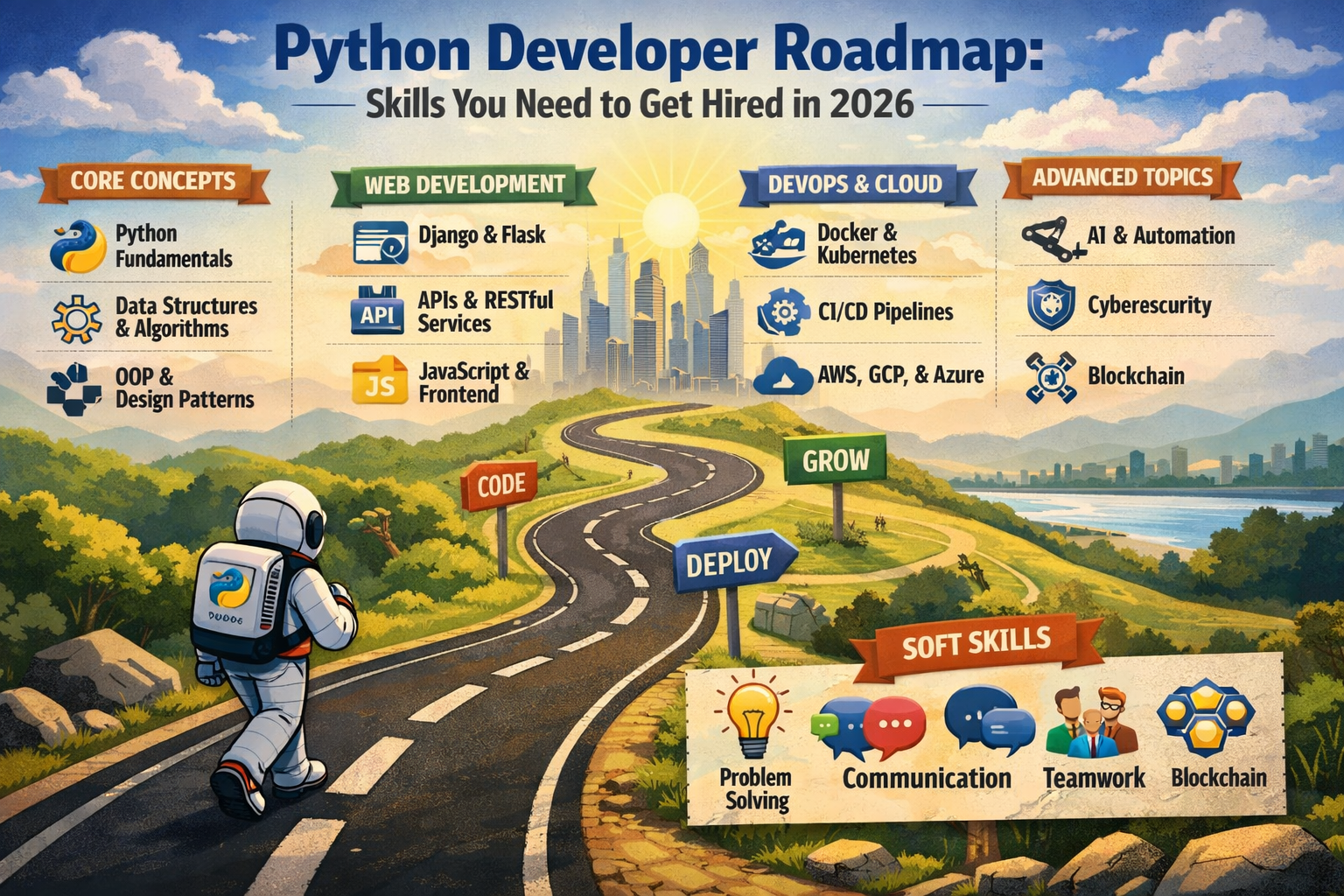
Python Developer Roadmap: Skills You Need to Get Hired in 2026
Python continues to dominate the tech world, thanks to its simplicity, versatility, and powerful libraries. In 2026, Python developers are in high demand across multiple domains, from web development and automation to data science and AI. But with increasing competition, knowing Python alone is not enough. Employers are looking for developers who can combine core Python knowledge with modern tools, frameworks, and problem-solving skills.
If you’re aiming to get hired as a Python developer in 2026, here’s a roadmap of the essential skills you need to master.
1. Core Python Programming
Before diving into frameworks and libraries, a solid foundation in Python is essential. Focus on:
- Data types and variables – strings, lists, dictionaries, tuples
- Control structures – loops, if-else conditions
- Functions and modules – reusable code and modular programming
- Object-Oriented Programming (OOP) – classes, objects, inheritance, and polymorphism
- Error handling – exceptions, try-except blocks
Strong fundamentals will help you adapt to any Python-based technology quickly.
2. Data Structures and Algorithms
Employers expect Python developers to have a good understanding of data structures and algorithms. This knowledge is crucial for problem-solving, optimizing code, and cracking technical interviews. Key areas to focus on include:
- Lists, stacks, queues, sets, and dictionaries
- Trees, graphs, and linked lists
- Searching and sorting algorithms
- Time and space complexity basics
Practicing coding problems on platforms like LeetCode, HackerRank, or CodeSignal can significantly improve your skills.
3. Web Development with Python
Python is widely used in web development. Knowing at least one modern web framework will increase your employability:
- Django – a high-level framework for building full-stack applications quickly
- Flask – a lightweight framework for building scalable web APIs
- FastAPI – for building fast, asynchronous APIs
Additionally, familiarity with HTML, CSS, JavaScript, and front-end frameworks like React or Vue.js will give you an edge in full-stack development roles.
4. Database Knowledge
Almost every Python project requires database interaction. You should be comfortable with:
- Relational databases – MySQL, PostgreSQL, SQLite
- NoSQL databases – MongoDB, Redis
- Writing queries, performing CRUD operations, and designing schemas
- Understanding ORMs like SQLAlchemy or Django ORM
5. APIs and Web Services
Modern applications rely heavily on APIs. A Python developer should know how to:
- Build RESTful APIs using Flask, Django REST Framework, or FastAPI
- Work with third-party APIs using requests or HTTP libraries
- Understand JSON, XML, and HTTP protocol
6. Testing and Version Control
Quality and collaboration are key in professional development:
- Version control – Git, GitHub, GitLab
- Testing frameworks – unittest, pytest, or Django’s built-in testing tools
- Writing clean, maintainable, and testable code is essential for team projects
7. Data Science, Machine Learning, or Automation (Optional but Valuable)
Depending on your career path, additional Python skills can give you an advantage:
- Data Science – pandas, NumPy, Matplotlib, Seaborn
- Machine Learning – scikit-learn, TensorFlow, PyTorch
- Automation/Scripting – Selenium, BeautifulSoup, PyAutoGUI for automating tasks
Specializing in one of these areas can make you more attractive to employers in 2026.
8. Soft Skills and Problem-Solving
Technical skills alone aren’t enough. Employers look for developers who can:
- Solve real-world problems efficiently
- Communicate ideas clearly
- Work collaboratively in teams
- Adapt quickly to new tools and frameworks
9. Portfolio and Projects
Building a strong portfolio of projects is critical. Include:
- Web apps, APIs, or scripts you’ve developed
- GitHub repositories with clean, documented code
- Contributions to open-source projects
A well-rounded portfolio demonstrates your practical experience and readiness for professional roles.
The Python developer roadmap in 2026 goes beyond just learning the language. It combines strong fundamentals, modern frameworks, database knowledge, problem-solving skills, and hands-on projects. By following this roadmap, you can position yourself as a competitive candidate, capable of delivering real-world solutions and thriving in professional environments.
Remember: learning Python is a journey. The more you practice, build projects, and stay updated with industry trends, the faster you’ll get hired.